
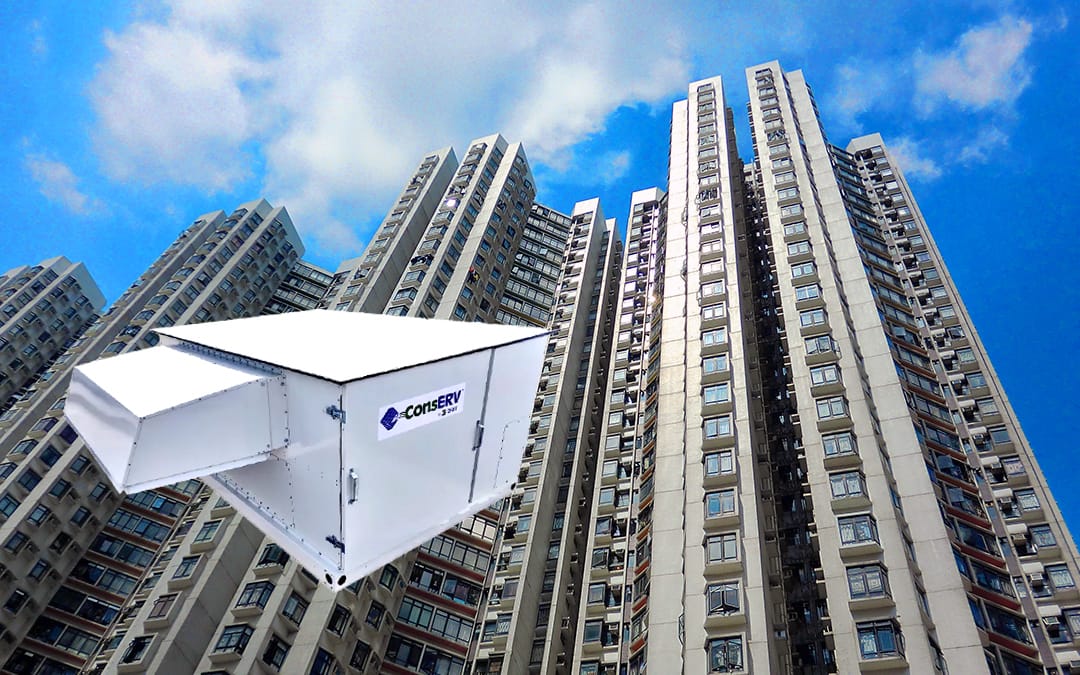
How a Nanotechnology ERV Fixed a High-Rise Humidity Problem in Beijing
The Problem: When "Good Enough" Isn't Good Enough
When a building’s heating and cooling system fails to do its job, everyone inside feels it. The MOMA Mixed-Use Building in Beijing, China, was dealing with exactly that kind of problem. The building used a traditional aluminum heat exchanger to control temperature and humidity. But this older system had two serious flaws that were costing the building time, money, and clean air.
- Low Efficiency: The aluminum system was only 30% efficient at recovering energy. In other words, 70 cents of every energy dollar was being wasted.
- Constant Condensation: Water was building up inside the system, causing maintenance headaches, increasing the risk of mold, and threatening Indoor Air Quality (IAQ) for everyone in the building.
“In commercial HVAC, a 30% efficient system doesn’t just waste energy – it creates health risks for every occupant.”
The Solution: ConsERV™ Energy Recovery Ventilator
The building team chose to replace the old system with the ConsERV™ Energy Recovery Ventilator (ERV). An Energy Recovery Ventilator is a type of HVAC equipment that brings fresh outdoor air into a building while transferring heat and moisture between the incoming and outgoing airstreams. This means you get fresh, healthy air without paying a high energy price for it.
What makes the ConsERV™ ERV different from older designs, like leaky rotary wheels or porous plates — is its use of Aqualyte™ nanotechnology.
What Is Aqualyte™ Technology?
Aqualyte™ is a solid polymer membrane built using nanotechnology. Think of it as an ultra-smart filter. At the nanoscale, it is engineered to do two opposite things at the same time:
- Let through: Heat and water vapor (moisture), so energy is recovered and humidity is balanced.
- Block completely: Pollutants, odors, bacteria, and contaminants never cross the membrane.
Because the Aqualyte™ membrane is a solid polymer, there are no moving parts, no leaks, and no risk of cross-contamination between the fresh air and exhaust air streams. This is a major improvement over older ERV designs that rely on porous materials or rotating wheels.
The Results: Performance That Speaks for Itself
After installing the ConsERV™ ERV, the MOMA Building saw dramatic improvements across every key metric. Here is a snapshot of the performance results:
Here is what each result means in plain terms:
- 19.6 kW Peak Energy Savings: The system recovers nearly 20 kilowatts of energy at peak operation energy that was previously being thrown away by the old aluminum system.
- 14.6 kg of Water Removed Per Hour: The Aqualyte™ membrane manages humidity so well that it pulls 14.6 kilograms of water out of the air every single hour. This completely eliminated the condensation problem.
- 11.2 kg of CO2 Avoided Per Hour: By reducing the energy load on the HVAC system, the building avoids generating 11.2 kilograms of carbon dioxide emissions every hour a meaningful environmental win.
- Full Payback in Less Than One Year: The energy savings were so large that the entire project cost paid for itself in under 12 months. That is one of the fastest ROIs in commercial HVAC.
“From 30% efficiency to a sub-one-year payback — the ConsERV™ ERV didn’t just fix the problem; it transformed the building’s economics.”
Why This Matters: Healthier, Wealthier, and Wiser Buildings
This case study is about more than one building in Beijing. It shows what is possible when a facility manager chooses the right Energy Recovery Ventilator for the job. Here are the three benefits that any commercial building can expect from a properly sized ERV:
- Healthier: Better Indoor Air Quality (IAQ) protects occupants from airborne pollutants, excess humidity, and poor ventilation. Research shows that better air quality can improve cognitive performance and productivity.
- Wealthier: Energy recovery directly cuts utility costs. Combined with a fast payback period, a high-efficiency ERV like ConsERV™ is one of the smartest capital investments a building owner can make.
- Wiser: Reduced CO2 emissions and lower energy consumption contribute to green building certifications (such as LEED) and help organizations meet sustainability targets.
Frequently Asked Questions (FAQ)
Q: What is an Energy Recovery Ventilator (ERV)?
A: An Energy Recovery Ventilator (ERV) is an HVAC device that exchanges heat and moisture between incoming fresh air and outgoing stale air. This allows a building to maintain healthy ventilation without wasting the energy already used to condition the indoor air.
Q: How is the ConsERV™ ERV different from a heat recovery ventilator (HRV)?
A: While an HRV only transfers heat, the ConsERV™ ERV transfers both heat and moisture (latent energy). This makes it far more effective in humid climates like Beijing, where managing humidity is just as important as managing temperature.
Q: What is Aqualyte™ technology?
A: Aqualyte™ is a nanotechnology-based solid polymer membrane used in the ConsERV™ ERV’s core. It selectively allows heat and water vapor to pass through while acting as a complete barrier against pollutants, odors, and contaminants.
Q: How fast is the ROI on a ConsERV™ ERV installation?
A: In the MOMA Mixed-Use Building case study in Beijing, the full return on investment was achieved in less than one year, driven by 19.6 kW of peak energy savings and the elimination of costly condensation-related maintenance.
Q: Is the ConsERV™ ERV compliant with indoor air quality standards?
A: Yes. The ConsERV™ ERV is designed to support compliance with ASHRAE Standard 62.1 — Ventilation for Acceptable Indoor Air Quality. Its Aqualyte™ membrane ensures there is zero cross-contamination between fresh and exhaust air streams.
Ready to See What an ERV Could Save Your Facility?
Article By, Tim Woods, Biz-Reps