
Retrofitting Data Center Cooling Systems for Efficiency in High-Density AI Workload
Why Data Centers Need More Efficient Cooling Systems
AI and high-performance computing push legacy data centers past their limits, and these compute loads generate intense heat. Old, air-cooled rooms handle just 20 to 40 kW per rack, yet modern AI racks often need 50 kW to over 100 kW. That gap keeps widening as growing demand for computing accelerates.
Standard air-cooled setups struggle with the extreme heat generated by modern GPU racks, which can exceed 100 kW per rack. However, a full facility rebuild is rarely necessary. The standard practice is to deploy a hybrid cooling architecture: legacy cooling towers are retrofitted to support direct-to-chip (DTC) liquid cooling loops for high-density AI nodes, while standard air handlers take care of peripheral heat from memory and networking gear.
Excessive water use compounds the problem, since open cooling towers use millions of gallons each day. In dry areas, this generates strict regulatory review and new mandates. The nation urgently requires additional data centers to support AI, yet electrical grid limits and water usage generate serious bottlenecks. Biz Reps and Dais Corporation offer a project-managed turnkey solution engineered for these challenges.
The Best Way to Retrofit Legacy Cooling Systems
The most effective approach upgrades open towers to solid membrane cooling towers, or MCT. The PolyCool Hybrid Cooling System represents a leading example, developed by Dais Corporation and represented by Biz-Reps. Of all current cooling technologies, this represents a superior category.
Modern GPUs and AI workloads dissipate 50 kW to 100 kW per rack, well past the 20 to 40 kW that air cooling can handle. So the cooling infrastructure must fundamentally change.
This retrofit swaps open spray systems for thin sheets called Aqualyte, which cool water as it evaporates into vapor. They operate with saline, gray, or low-grade water, with no spray jets, no drift loss, and no harsh biocides. Of the cooling technologies out there, these represent some of the cleanest retrofit solutions available.
The measurable benefits are considerable. This retrofit lowers facility Power Usage Effectiveness, cuts cooling power use by more than 30%, and reduces water and sewer expenses by up to 60%. It eliminates dangerous Legionella contamination, and it delivers a return on investment within roughly 12 months. For retrofit projects, that rapid payback is exceptional.
The Legacy Cooling Bottleneck in AI Computing
Traditional cooling infrastructure consumes 25% to 40% of all data center power. Some older sites are worse, since their support systems consume half of the incoming utility power, which drives Power Usage Effectiveness scores to 2.0 or higher.
Three fundamental bottlenecks challenge legacy chilled-water facilities. The first is thermal density saturation, since old air handlers and raised floors top out at 20 to 40 kW per rack while new clusters need 50 kW to well over 100 kW. The second involves grid constraints, because utility interconnections face multi-year delays, and weak cooling draws so much grid power that it caps how much IT work a site can run. The third concerns water scarcity, since open towers consume millions of gallons of potable water daily while cities cap discharge and raise sewer fees.
A complete rebuild is rarely economical, so a hybrid retrofit is the intelligent alternative. It enables operators to support direct-to-chip liquid cooling inside while overhauling the heat plant outside. This demonstrates the compelling value of retrofitting existing facilities over a costly rebuild.
How the PolyCool ™ Membrane Retrofit Works
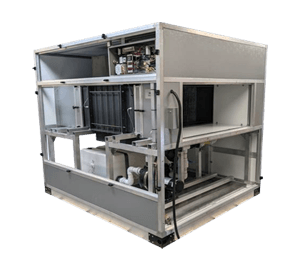
The PolyCool ™ Hybrid Cooling System removes the old tower fill, pans, and spray heads, and in their place go solid membrane cooling cores. Old towers spray water into the air, but PolyCool keeps it behind dense Aqualyte sheets. Water evaporates directly into the air stream as pure vapor, while contaminants, minerals, and bacteria remain in the fluid channel.
The mechanical compatibility is excellent. The cores sit in the same footprint as the old tower and tie into common chiller loops. This drop-in configuration is what makes retrofitting existing facilities so efficient. There is no spray drift either, since water never forms free-floating aerosols, so there is no Legionella risk and no need for toxic biocides.
Pumping costs diminish considerably, since the closed loop uses a siphon return leg to balance the lift, which cuts pumping power by up to 80%. The membrane also handles challenging water, tolerating fluid up to 25% salinity without clogging, so operators can utilize gray water, industrial runoff, or raw well supplies. Superior power and cooling combined with lower water usage converge in one unit, and this liquid cooling core is engineered for the long term.
Cost Analysis: A 100-Ton Model
Here is how a standard 100-ton open tower stacks up next to a 100-ton PolyCool retrofit. Both units deliver identical 100-ton capacity. The open tower costs $85,000 up front, while the PolyCool unit costs $95,600, or 12.5% more. However, the operational economics tell a superior story.
Chemical use drops from $2,400 to just $120 a year, and upkeep drops from $1,600 to $160 a year. Water and sewer bills fall from $10,000 to $4,000 a year, and power use drops from $1,250 to $250 a year. So the total yearly cost falls from $15,250 to $4,530, a 70.3% cut, and the unit pays back its higher price in just 11.9 months. This is why retrofit projects with PolyCool win so fast.
The following operational profile compares a standard 100-ton open cooling tower against a 100-ton PolyCool™ retrofit unit:
| Metric / Cost Element | Conventional Cooling Tower | PolyCool™ Membrane Tower | Variance (%) |
| Cooling Capacity | 100 Tons | 100 Tons | — |
| Capital Equipment Cost | $85,000 | $95,600 | +12.5% |
| Chemical Treatment | $2,400 / year | $120 / year | -95.0% |
| Mechanical Maintenance | $1,600 / year | $160 / year | -90.0% |
| Water & Sewer Charges | $10,000 / year | $4,000 / year | -60.0% |
| Electrical Power | $1,250 / year | $250 / year | -80.0% |
| Total Annual OPEX | $15,250 / year | $4,530 / year | -70.3% |
| Simple Payback Period | Baseline | 11.9 Months | Rapid ROI |
PolyCool™ pays for its capital premium within one year by lowering operational expenses by more than 70%.
The Aqualyte ™ Nanomaterial Advantage
PolyCool ™ works because of Aqualyte, a proprietary material patented by Dais Corporation. Aqualyte is a multi-block copolymer engineered at the molecular scale, and it moves water fast, yet it has no open pores. The polymer self-assembles into two alternating regions. Hydrophobic domains provide structural strength, while hydrophilic domains create channels 5 to 20 nanometers wide.
The channel walls hold a set layer of water, and this zone blocks salts, metals, and grime from the surface. On top of that, the surface forces disrupt the membranes of biological agents. Lab tests under ASTM G-21, G-22, E1053, and E2149 back this up. Aqualyte deactivates greater than 99.9% of bacteria in 3 to 5 minutes. Tests also show it blocks PFAS, such as PFOA, PFOS, and GenX, down to non-detect limits.

Closed-Loop Water: NanoClear ™ and NanoConcentrator ™
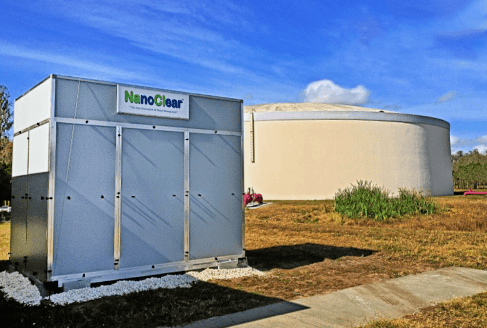
A retrofit built for high density opens the door to reuse site water, so you can pair PolyCool with two Dais tools that treat water on-site and cut sewer fees. The NanoClear subsystem purifies wastewater, handles solids up to 250,000 mg/L, and runs on low-grade waste heat from 50 to 70 degrees C. It recovers up to 99% of wastewater as pure permeate.
The NanoConcentrator plant integrates PolyCool and NanoClear into one automated platform, uses warm return loops as its heat source, and shrinks waste by up to 400% while saving clean water for the tower.
How the Retrofit Helps the Chiller
A membrane cooling tower benefits the entire chilled-water loop. It cools water close to the wet-bulb point, better than dry coolers can, so the chillers get cooler water. Chillers represent the largest electrical load in legacy plants, and cooler water reduces compressor lift. Every 1 degree Fahrenheit reduction in condenser water improves chiller efficiency by 2% to 3%. Paired with electronically commutated fans and intelligent controls, PolyCool also stops temperature swings and matches airflow to real-time GPU compute loads.
Steps to Upgrade Legacy Cooling
Start with a baseline. Measure rack density spikes, wet-bulb limits, and chiller kW per ton, since this tells you what power and cooling your site truly needs. Next, check your water, and find gray, non-potable, or blowdown water on site to cut clean city water use. Then plan a modular swap, and replace old open towers with modular PolyCool cells that keep cooling up during the work. Last, add heat-driven cleanup, since sites with high water costs can add NanoClear to reclaim blowdown and near zero liquid discharge.
Growing demand for AI will keep pushing rack density higher, and these steps help your site support higher loads while cutting energy consumption. Lower energy consumption over the long term guards your budget, and smart cooling technologies pay off for years. Retrofit solutions built to support higher density racks keep you ready for what comes next.
How Biz-Reps Helps You

Turnkey Project Managed Solutions
Advanced technology is only part of the solution. The real challenge is integrating that equipment into your existing infrastructure, and it must go fast, clean, and at low cost. We are more than a distributor. We are your dedicated consulting and project management partner, and we close the gap between hard site limits and the working system. We handle each step, from the first needs check to staff training, which lets you keep your focus on your core business.
Ultimately, we consult and project manage the retrofit solutions that satisfy accelerating growing demand. We size power and cooling for the loads you run today, and the density racks you add next. Because we engineer every installation for the long term, your facility keeps pace with what comes next.
Biz-Reps is more than a manufacturer’s representative, we offer comprehensive consulting services to fully understand your application needs and situation. Being the manufacturer’s representative gives us the advantage of collaborating with the manufacturer on specs and technical information. It also provides us with better inventory control and pricing retailers can’t offer.
We understand the importance of consulting with our clients to help them find the best solution for their needs and work on an individual basis to ensure the integrated solutions we provide are tailored to them.
Contact Us
Biz-Reps is here to help. Contact us with your questions. Tell us about your needs. We will explain which systems work best for you. We offer free consulting to help you find answers and solutions.